
What Salt Air Actually Does to an AC Coil
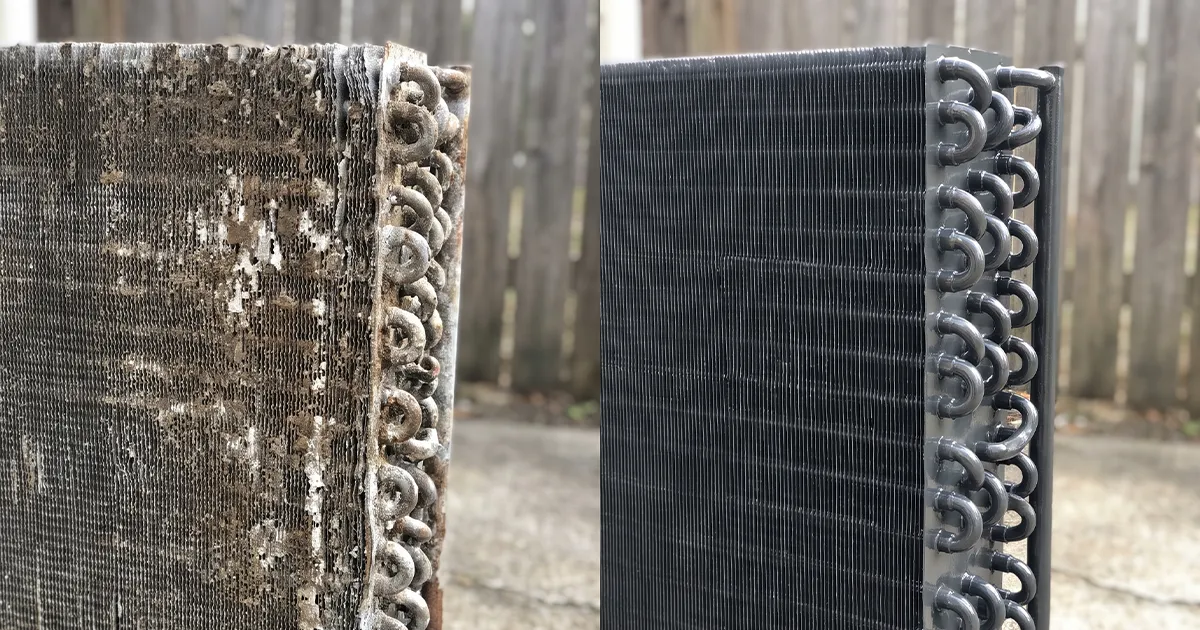
An outdoor coil is built from aluminum fins wrapped around copper tubing, two different metals sitting right next to each other. Salt and humidity together form a thin electrolyte film on the surface, and once that film is there, the coil essentially becomes a small battery. Copper holds onto its electrons more strongly than aluminum does, so the aluminum ends up sacrificing itself to protect the copper, corroding first and fastest. The fins are the ones that pay for it: they thin out, flake, and eventually crumble, and every bit that’s lost is contact area the coil needs to move heat efficiently.
Why It Costs More Than It Looks Like
That’s the part that shows up on a utility bill and an early replacement quote. A coil losing fin surface to corrosion has to work harder to do the same job, and a system inland might run 10 to 15 years on its original coil while the same system parked near open salt water can be down to 3 to 5 before it needs real intervention. It’s not that coastal systems are built worse. They’re fighting a chemical process inland systems barely deal with at all.
What Coastal Coil Coating Actually Does
A protective coating creates a barrier between the metal and the salt-laden air, which interrupts the electrolytic path that makes the corrosion possible in the first place. Wentzel’s applies this in-house on coastal properties rather than subcontracting it out, which means it happens as part of a regular service visit instead of requiring a separate appointment with a different company. It’s not a substitute for basic upkeep though. A periodic rinse with fresh water to clear off accumulated salt still matters, coating or not, and Wentzel’s will say so rather than implying the coating alone solves everything.
Coating vs. Sacrificial Anodes
Coating isn’t the only method used against this kind of corrosion. A sacrificial anode, a separate piece of metal clamped near the coil, can be used to draw the corrosive reaction toward itself instead of the coil, the same principle boat owners use to protect a hull. Wentzel’s approach centers on coating rather than anodes for most residential and condo applications, since it protects the full coil surface directly rather than relying on a single sacrificial point.
Who Actually Needs This
Properties directly on the water, canal-front homes, and barrier island communities like Siesta Key see the fastest coil corrosion in the service area, simply because they get the most consistent salt exposure. Condominium associations managing common-area equipment on these kinds of properties deal with it at scale: more units, more exposed coils, more of the budget going toward early replacements if nothing is done about it.
The risk isn’t limited to properties directly on the Gulf. Canal-front homes in bay-adjacent neighborhoods, and units close enough to open water on the barrier islands, all deal with meaningfully more salt exposure than a property even a mile or two further inland. Distance from open water is the single biggest factor in how fast a coil actually corrodes.
Coastal Coil Coating Questions
Is coastal coil coating something every AC unit in the area needs?
Not necessarily. Systems well inland rarely deal with enough salt exposure to justify it. It matters most for properties directly on the water or close enough that salt air is a daily reality, not an occasional one.
How much faster does an uncoated coil actually corrode near the coast?
It varies by exact distance from the water and how exposed the unit is, but a system that might run 10 to 15 years inland can be down to 3 to 5 years near open salt water without protection.
Does the coating mean I can skip rinsing my unit?
No. A coating slows the corrosion process, it doesn’t eliminate the need for basic maintenance. Rinsing off accumulated salt with fresh water periodically still matters for coil life either way.
Can this be added to an existing unit, or only new installations?
It can typically be applied to an existing coil during a service visit, not just at installation, though the condition of the coil at that point affects how much benefit is left to gain.
Does a sacrificial anode work better than a coating?
They protect differently rather than one being universally better. An anode draws the corrosive reaction to itself and needs periodic replacement once it’s spent. A coating protects the coil surface directly and doesn’t wear out the same way, which is part of why Wentzel’s leads with coating for most residential and condo work.
Do condo associations request this for common-area equipment?
Regularly, especially for properties on Siesta Key and other waterfront communities where Wentzel’s already coordinates AC service for entire buildings through the condominium and vacation-rental HVAC program.